

Once is a dating app built around the idea of mindful dating and one curated match a day instead of endless swiping. That core promise is still central to how the brand presents itself. It positions itself as a quality dating app focused on helping users connect through daily matches, shared vibes, and more intentional interaction.

That makes the app stand out immediately. Many dating platforms compete by giving users more profiles, more speed, and more constant browsing. Once goes in the opposite direction. It tries to slow the process down, reduce swipe fatigue, and frame dating as something more selective and less chaotic. For some users, that sounds refreshing. For others, it may feel slower than mainstream dating apps.
Last Updated: February 2026
What Is Once?
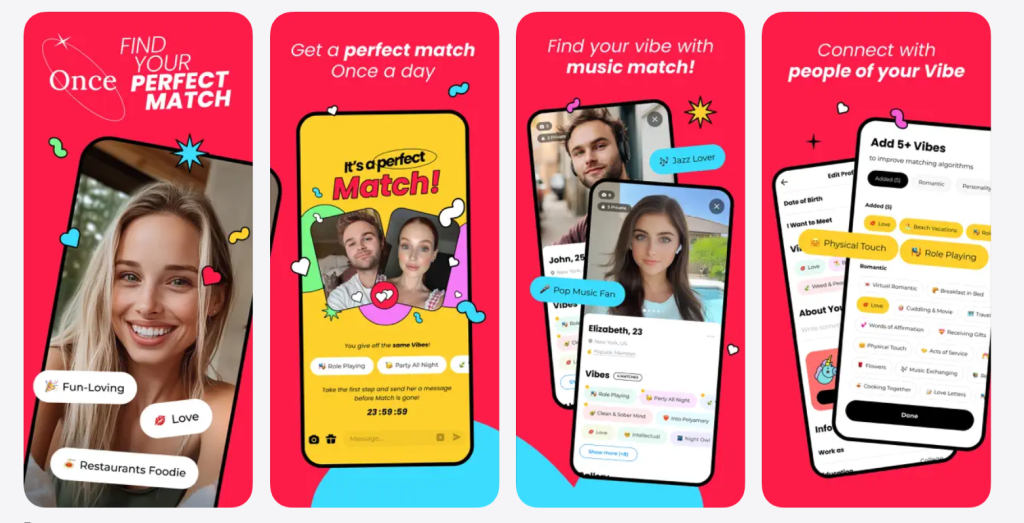
Once is a mobile dating app that presents itself as a mindful dating platform focused on genuine connections rather than fast, high-volume swiping. In simple terms, it is designed for users who want fewer, more deliberate matches instead of an endless feed of profiles. Its core identity is still tied to the idea of getting one strong match a day.
At the same time, Once is no longer framed only as a strict “one match and that’s it” app. Its current positioning also highlights added flexibility around how users match, meet, chat, and date, which suggests the platform has evolved beyond its original ultra-simple concept. The brand now leans into features tied to vibe-based matching and music compatibility, which gives it a broader dating identity than a purely minimalist daily-match app.
In category terms, Once is best understood as a platform-specific dating app with a slower, more intentional positioning. It is still a mainstream consumer dating product, but its branding is built around restraint, compatibility, and reducing the pressure of constant swiping.
How This Once Review Was Evaluated:
- Clarity of the app’s core dating concept
- Ease of understanding the daily-match model
- Feature depth beyond the original one-match promise
- Pricing structure and how paid access appears to shape the experience
- Privacy and trust considerations typical of dating apps
- Mobile-first usability and overall app flow
- Practical value compared with faster, swipe-heavy alternatives
This review focuses on the current positioning of Once, how the app appears to balance mindful dating with newer matching features, and whether that slower approach still offers real value in a market full of fast, high-volume competitors.
How Once Works
At its core, Once works like a dating app with a more deliberate pace. The central idea is that the user receives one strong match each day instead of being pushed into endless browsing. That daily-match concept remains the foundation of the product.
From there, the app appears to build out the experience with more flexibility than the brand’s original reputation might suggest. The app now gives users more choices in how they match, meet, chat, and date. That matters, because it signals the app is not trying to trap users inside a single rigid format. Instead, it keeps the mindful dating angle while adding more routes for interaction.
The platform also leans into compatibility cues. It highlights “vibes” and promotes matching around shared energy or interests, while also advertising a Spotify Match feature that links music taste to matchmaking. That gives Once a more personality-led identity than a plain swipe app. Rather than competing only on volume, it is trying to compete on relevance and emotional fit.
In practical terms, Once appears to suit users who are tired of the constant churn of swipe-based apps. It is built for people who would rather consider fewer matches more carefully, even if that means slower momentum. That slower rhythm can be a strength, but only for users who genuinely want that style of dating.
Key Features and Standout Tools
The biggest standout feature is the one match a day model. That is the app’s defining promise and the main reason people remember the brand. Even with newer features added, this remains the core identity of Once and the clearest difference between it and mainstream swipe-first competitors.
The second standout feature is mindful dating positioning. Once does not market itself as a fast, addictive swipe product. It markets itself as a calmer alternative focused on genuine connections. That branding is a feature in itself because it shapes what kind of user the app attracts and what kind of experience it promises.
The third standout area is vibe-based matching. The app references matching based on “vibes,” which suggests the platform is trying to move beyond surface-level browsing and toward a more personality-driven experience. That may appeal to users who want the app to feel more human and less mechanical.
The fourth is Spotify Match. Once promotes music-based matching through Spotify, which gives the app a more modern, interest-led layer. Music compatibility is not a magic solution, but it can help conversations start more naturally and can make the app feel more specific than generic dating products.
Finally, the app now gives users flexibility in how they match and chat. That is important because it suggests the product has become broader than its original minimalist pitch, which may make it more usable for people who like mindful dating without feeling boxed in.
Is Once Private, Safe, Reliable, or Trustworthy?
Once presents itself as a legitimate, currently maintained dating service with an active official website and current mobile app listings. That alone separates it from abandoned or questionable dating apps with no visible maintenance. It appears to still be actively distributed and updated, which is a useful trust signal.
That said, no dating app should be treated as automatically safe just because it is active and polished. The same basic rules apply here as on any other dating platform: users should avoid sharing sensitive information too early, watch for inconsistent behavior, and verify people properly before meeting in real life. This is especially important on apps that emphasize emotional compatibility, because that branding can make people lower their guard too quickly.
In trust terms, Once sits in a middle ground. Its official materials are clear and current, which helps. But public review summaries also suggest that some users raise concerns about pricing and the overall quality of the experience. That does not prove the app is unreliable, but it does mean it should be approached with normal caution rather than blind trust.
The fairest conclusion is that Once appears legitimate and active, but like most dating apps, it should be judged through practical use, careful subscription decisions, and sensible online dating habits.
Pricing, Payments, and Subscription Structure
Once is available as a free download through major app stores, which means users can access the app without paying upfront just to install it. That creates a low barrier to entry and makes it easier to test the platform before committing.
At the same time, the app should not be viewed as purely free in a practical sense. Dating apps in this category typically rely on premium upgrades, and user complaints visible in public summaries suggest that pricing and paid access are meaningful parts of the experience. Because public snippets do not always show one clearly stated universal price, the smartest approach is to assume that exact costs can vary and should be checked directly inside the app before any purchase is made.
This matters because Once’s positioning can attract users who are already tired of manipulative app dynamics. If paid features feel too central, that can weaken the “mindful” brand promise. On the other hand, if the paid layer mainly improves convenience rather than blocking the core experience, some users may still find value in it. The key point is simple: pricing should be verified in real time before subscribing.
For review purposes, Once is best described as a free-to-start dating app with a likely premium layer that users should evaluate carefully before paying.
User Experience (Mobile, Desktop, Sign-Up, Setup, Ease of Use, etc.)
Once is clearly a mobile-first dating app. Its main public presence is through app-store listings and a consumer-facing website that pushes users toward the app experience, which is typical for dating products in this category.
From a user-experience perspective, the main advantage is mental simplicity. The one-match-a-day idea reduces overload. That can make the app feel calmer, more intentional, and less exhausting than platforms built around constant profile churn. For users who feel burned out by swiping, that is a genuine appeal.
The trade-off is speed. A slower rhythm can feel elegant when the match quality is strong, but it can feel frustrating when a user wants more momentum. This is where Once becomes highly preference-dependent. Someone who values patience may enjoy the format. Someone who wants fast discovery may find it too restrictive.
The newer features help soften that issue. Because Once now talks about more flexible ways to match, meet, and chat, the app seems less rigid than its old reputation suggests. That could make it more appealing to users who like the mindful concept but still want a bit more movement in the experience.
Pros and Cons
Pros
- Strong, memorable concept built around one match a day
- Clear mindful-dating positioning for users tired of endless swiping
- Added vibe and music-based matching give the app more personality
- Free to download and easy to test at a basic level
- Active app listings suggest the service is still maintained
Cons
- Slower pace will not suit users who want high-volume browsing
- Real value depends heavily on match quality, not just the concept
- Pricing details should be checked carefully before paying
- Some public review summaries raise concerns about overall experience quality
- The mindful brand promise can feel less compelling if paid access becomes too central
Once vs Alternatives
Once competes best against swipe-fatigue, not against every dating app equally. Its true rival is the feeling many users get on mainstream apps: too many profiles, too little intention, and too much repetitive browsing. Once answers that problem by slowing everything down and making each match feel more deliberate.
Compared with Tinder, Once is much slower and more selective in tone. Tinder is built for speed, reach, and constant movement. Once is built for restraint and quality signaling. Compared with Hinge, Once is also more rigid in concept, while Hinge tends to give users more direct profile interaction and conversational prompts. Compared with Inner Circle, Once feels less exclusive and more centered on mindful pacing than on community status or curated branding.
That makes Once strongest for a specific type of dater: someone who wants fewer options, less overload, and a more intentional rhythm. It is weaker for users who want maximum activity, broader choice, or faster results.
Comparison Table: Once vs Other Platforms
| Platform | Best For | Pricing / Free Version |
Key Advantage | Main Drawback |
|---|---|---|---|---|
| Once | Users who want slower, mindful dating | Free to start; paid elements likely apply | One match a day and lower swipe fatigue | Too slow for users who want more momentum |
| Tinder | Fast, mainstream dating | Free version with paid upgrades | Huge user base and fast discovery | Can feel crowded and repetitive |
| Hinge | Users who want deeper profile interaction | Free version with paid upgrades | Better prompt-led conversations | Still more browsing-heavy than Once |
| Bumble | Users who want a more structured modern app | Free version with paid upgrades | More guided communication flow | Local activity can vary a lot |
| Inner Circle | Users who want a more curated dating environment | Free to start; stronger value tied to paid access | More exclusive, filtered feel | Can feel restrictive or status-focused |
The table makes the core point clear: Once is not trying to win on volume. It is trying to win on pace, focus, and emotional breathing room. Whether that feels smart or limiting depends entirely on what the user wants from a dating app.
FAQs: Once
Is Once a real dating app?
Yes. Once has an active official website and current listings on major app stores.
What is Once known for?
It is best known for its one-match-a-day concept and mindful dating positioning.
Is Once free to use?
It is free to download, but users should expect some form of paid upgrade or premium access within the app.
Does Once still focus on one match a day?
Yes. That message is still central to how the app presents itself.
Is Once only for serious relationships?
Its branding leans toward genuine, more intentional connections, but actual outcomes will still depend on the user base and how individuals use the app.
Does Once have more features than just daily matching?
Yes. It also highlights vibe-based matching, Spotify Match, and more flexible ways to meet and chat.
Is Once better than Tinder?
That depends on preference. Once is better for users who want less overload, while Tinder is better for users who want faster, broader browsing.
Is Once good for people tired of swiping?
Yes. That is one of its clearest use cases, since it is designed to reduce endless swiping.
Does Once work on mobile?
Yes. It is a mobile-first app.
Is Once safe?
It appears to be a legitimate, active app, but users should still use standard dating-app precautions.
Can music affect matching on Once?
Yes. The app promotes a Spotify Match-style feature tied to music compatibility.
What does “mindful dating” mean on Once?
In this context, it means a slower, more deliberate approach to matching, with less emphasis on endless profile browsing.
Should users check pricing before paying?
Yes. Exact costs and the value of paid access should always be verified in-app before subscribing.
Who is Once best for?
It is best for users who want a calmer, more intentional dating experience and do not mind slower pacing.
Final Verdict: Once
Once is a strong concept-first dating app for users who want relief from the chaos of modern swipe culture. Its biggest strength is not raw feature volume. It is the clarity of its promise: fewer matches, more intention, and a slower pace that can make online dating feel less noisy. The current version also appears broader than the brand’s original reputation, with added flexibility and compatibility features layered on top of the daily-match idea.
That said, the app will never be the right fit for everyone. Its slower rhythm can feel thoughtful to one user and frustrating to another. The real test is whether the quality of the matches justifies the reduced quantity. Pricing should also be checked carefully before paying, especially if there are concerns about the value of premium access.
For users who want intentional pacing, less swipe fatigue, and a dating experience built around quality over quantity, Once remains a relevant option in the category. It is not the broadest or fastest app, but that is exactly the point. For the right user, Once can still make more sense than a high-volume dating platform.