
ChitChat is built for people who want instant conversations with strangers without the awkward “where do people even start?” moment.
Popular Alternatives:


The niche has matured fast: users now expect quick matching, fewer bots, and real controls—because random chat is only fun when it feels safe, smooth, and worth the time.
Last Updated: January 2026
How This ChitChat Review Was Evaluated
- Moderation strength: reporting tools, enforcement style, and how quickly bad behavior can be removed
- Privacy/anonymity controls: what’s shared by default, what can be hidden, and what cannot
- Pricing transparency: whether paid add-ons are clear, optional, and explained upfront
- Ease of use (mobile/desktop): how fast it loads, how clean the flow is, and how few steps it takes to start
- Bot/spam prevention: friction points like verification, limits, and behavior detection
- Filtering options: whether filters exist, how they work in practice, and what users should expect
- Overall user safety: realistic risks, guardrails, and the quality of the “escape hatch” (block/report/leave)
What Is ChitChat?
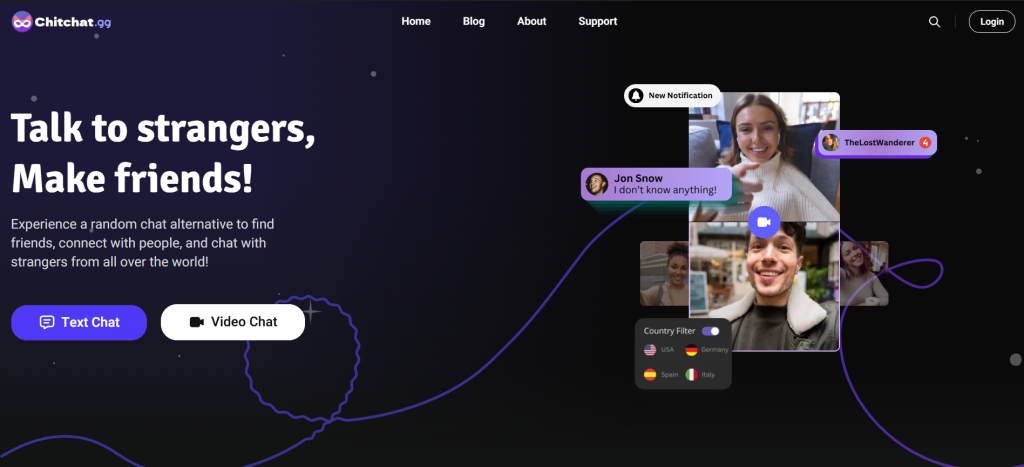
ChitChat is a chat platform designed for meeting new people quickly through stranger chat—typically via text chat and, where available, live video chat. It sits in the same broad category as “chat with strangers” and “Omegle alternative” platforms, but leans toward a more rules-driven experience rather than total anything-goes chaos.
Quick answer: ChitChat is for fast, one-on-one conversations with strangers using text and/or video, with rules, reporting, and optional filters that try to keep the experience cleaner than older roulette-style sites.
What it is:
- A place to start chatting fast, usually without complicated setup
- A platform that aims to reduce obvious spam and abusive behavior through rules + reporting
- A way to socialize, pass time, and meet people outside a follower-based social network
What it is not:
- Not a dating app (even if some users treat it like one)
- Not a private messenger for people already known in real life
- Not a guaranteed-safe space (no random chat platform can promise that)
How ChitChat Works
The core flow is simple: open the platform, choose a chat mode, and get matched. The best random chat products remove friction so the user spends time talking—not troubleshooting.
A typical ChitChat-style session looks like this:
- Enter the app/site and choose text chat or video chat (depending on what’s offered in that mode/region).
- Set preferences (optional), such as basic filters or interests.
- Start matching and land in a one-on-one conversation.
- Continue, skip, or report depending on how the chat goes.
There are usually three “layers” underneath that simple experience:
- Matching logic: how the platform finds the next partner (speed vs quality trade-off)
- Friction controls: steps that slow down spammers (verification, limits, detection)
- Safety rails: reporting, bans, and rules that try to keep things usable
Practical tip: the safest way to use any stranger chat platform is to treat every chat as disposable. If the vibe is off, leave instantly. No explanations needed.
Key Features and Standout Tools
ChitChat’s value is less about flashy gimmicks and more about whether it delivers consistent, usable chats without feeling like a minefield. The most meaningful features in this niche tend to be:
1) Text chat and video chat options
Some users prefer text-first because it’s low-pressure. Others want real-time video for authenticity and faster “is this a real human?” confirmation.
2) Filters (where available)
Common filters include location and gender. Filters can make the experience more relevant, but they are never perfect because they often rely on user-entered information.
3) Reporting and fast exits
In random chat, the “Leave” button is a safety feature, not just a navigation choice. A good platform makes leaving instant and reporting easy.
4) Rule-based environment
Platforms that clearly state what’s allowed (and enforce it) usually feel less chaotic than older roulette sites that depended on pure luck.
5) Anti-spam friction
This might include rate limits, challenges, or pattern detection. It’s not always visible, but when it works, the user feels it as “fewer obvious bots.”
Short, quotable take: The best feature in random chat is not a filter—it’s fast moderation plus an easy escape button.
Is ChitChat Anonymous?
ChitChat is typically semi-anonymous, not fully anonymous.
Here’s what “semi-anonymous” means in practice:
- A real name usually isn’t required to start chatting.
- The platform may still collect technical data (like device information, timestamps, and network details) to run the service and limit abuse.
- In video chat, certain technical details can be harder to hide completely, especially if peer-to-peer technology is involved.
Quick answer: ChitChat can feel anonymous because strangers don’t automatically see a real identity, but complete anonymity is not realistic on live chat platforms.
How to stay as anonymous as possible:
- Avoid sharing real names, personal socials, or location details
- Keep backgrounds neutral (no street signs, school logos, work badges)
- Use a separate email if an account is required
- Never treat “private chat” as private by default—assume screenshots can happen
Safety, Moderation, and Privacy Controls
This niche is defined by a blunt reality: anyone can show up. So the platform’s safety story depends on what happens after something goes wrong—and how easily it can be prevented in the first place.
A stricter platform typically includes:
- Clear age rules (commonly 18+)
- Community guidelines that explicitly ban harassment, threats, doxxing, and sexual content involving minors
- Video-specific rules (for nudity, explicit behavior, harassment, and recorded content)
- Report tools that send evidence to moderators (often a screenshot + chat context)
- Automated enforcement for repeat reports in short timeframes
- Appeal pathways for bans (sometimes available, sometimes limited)
Realistic safety expectations:
- Moderation can reduce harm, not eliminate it.
- Some bad behavior happens fast—so users still need fast exits and strong personal boundaries.
- Filters don’t equal safety. They equal sorting.
Actionable safety checklist (use every time):
- Start text-first if privacy matters.
- Leave instantly at the first red flag (rage, sexual pressure, threats, manipulation).
- Never “prove” anything to a stranger (age, location, identity).
- Report and move on—don’t argue.
- Keep the camera framing tight (face only, neutral background).
- Avoid showing screens, QR codes, or any identifying apps in view.
Pricing, Payments, and Subscription Structure
Most modern stranger-chat platforms run on a “free core + paid extras” model. The free version is designed to get users chatting quickly. Paid options are usually built around filters, boosts, or premium matching.
Common paid elements include:
- Gender or location filters
- Priority matching (faster connections, more “active” pool access)
- Reduced friction (fewer limits, longer sessions, premium queue)
Refund policies in this niche are often strict because:
- Filters rely on user-provided input and can be inaccurate.
- Digital goods and subscriptions are hard to “return” once consumed.
- Fraud and chargebacks are a persistent issue for these platforms.
Quick answer: Expect basic access to be free, and expect filters or premium controls to cost money. Filters are helpful—but not guaranteed accurate.
How to spend safely:
- Treat premium as a short test, not a long commitment.
- Pay only if the platform clearly explains what the upgrade changes.
- Avoid paying just to “find better people.” Pay only for a specific control that matters (like location filtering).
User Experience (Mobile, Desktop, Sign-Up)
In random chat, user experience is mostly about speed and clarity. If it takes too long to connect, people bounce.
What typically matters most:
- Time to first chat: how quickly a new user gets matched
- Stability: fewer disconnects, fewer frozen sessions
- Clarity: clear “Next,” clear “Report,” clear rules
- Mobile friendliness: solid camera permissions flow and layout that doesn’t fight the phone screen
Sign-up expectations:
- Some platforms allow “start now” with minimal setup.
- Others require an account to reduce abuse, manage bans, and handle payments.
- Verification steps can feel annoying—but often reduce spam.
Practical tip: If a platform forces sign-up before showing any value, it should compensate with better moderation and a cleaner chat pool. If it doesn’t, it’s not worth the friction.
Pros and Cons
Pros
- Faster entry into conversations than social apps built around profiles and followers
- Rules + reporting can create a cleaner vibe than older roulette platforms
- Filters (when available) help reduce randomness and improve relevance
- Text chat gives privacy-minded users a lower-pressure option
Cons
- No platform can guarantee safety; users still meet unpredictable strangers
- Filters can be inaccurate and can create false confidence
- Video chat always carries higher privacy risk than text
- “Better matches” is not something money can fully buy—behavior varies
Short, quotable take: Random chat is not about finding perfect people. It’s about finding decent conversations fast—and leaving the rest behind.
ChitChat vs Alternatives (5–10 Options)
ChitChat sits in a crowded category. The best alternative depends on what matters most: safety, filters, mobile experience, or pure randomness.
1) OmeTV
Strong for: quick matching and a large user base. Often feels more structured than older roulette sites.
2) Chatroulette
Strong for: classic roulette-style randomness. Quality varies by time and region.
3) Chatrandom
Strong for: multiple chat modes and broad discovery. Often includes filtering options.
4) Camgo
Strong for: simple, low-friction entry. Good for users who want quick access without complexity.
5) Emerald Chat
Strong for: a community-first approach and more structure. Better for users who dislike pure roulette chaos.
6) Shagle
Strong for: fast switching and filtering. A common pick for roulette-style video chat.
7) Azar
Strong for: mobile-first experience and smooth UX. Often used by people who prefer app-based matching.
8) CooMeet
Strong for: “cleaner” matching expectations and paid model focus. Typically less random, more controlled.
9) Monkey App
Strong for: fast, social-style video matching. Works best for users who like short, rapid interactions.
10) Thundr
Strong for: modern “Omegle alternative” positioning and quick matching. Quality varies by region.
Choosing the right alternative comes down to one question: is the priority more people, more control, or less risk? Typically, only two of those come at the same time.
Comparison Table
| Platform | Best For | Free Version | Moderation | Key Advantage |
|---|---|---|---|---|
| ChitChat | Rule-based stranger chat + filters | Yes (core access) | Medium-Strong | Clear rules + reporting flow |
| OmeTV | Quick matches with a big user pool | Yes (limited) | Medium | Fast matching and popularity |
| Chatroulette | Classic roulette randomness | Limited | Medium | Familiar roulette format |
| Chatrandom | Variety of chat modes | Limited | Medium | Multiple modes + filters |
| Camgo | Simple, quick entry | Yes (limited) | Medium | Low friction user experience |
| Emerald Chat | Structure + community feel | Yes (limited) | Medium-Strong | More organized conversations |
| Shagle | Filtered roulette video chat | Yes (limited) | Medium | Filters + fast switching |
| Azar | Mobile-first matching | Limited | Medium | Smooth mobile experience |
| CooMeet | Higher-control matching | Limited | Medium-Strong | Cleaner flow and paid controls |
| Monkey App | Short, fast interactions | Yes (limited) | Medium | Rapid matching on mobile |
FAQs on ChitChat
1) What is ChitChat used for?
ChitChat is used for meeting strangers for quick conversations through text chat and, where available, video chat. It’s designed for fast matching rather than profiles and long bios.
2) Is ChitChat safe to use?
It can be safer than older roulette platforms when rules and reporting are enforced, but it is never “fully safe.” The safest approach is fast exits, minimal sharing, and consistent reporting.
3) Is ChitChat anonymous or private?
It feels anonymous because strangers don’t automatically know a real identity, but it isn’t truly private. Like most live chat platforms, some technical data may be processed to run the service and handle abuse.
4) Does ChitChat require sign-up?
Depending on the feature (especially paid features), an account may be required. Some platforms allow quick start for basic chat and require sign-up for filters or premium controls.
5) Can users choose who they chat with on ChitChat?
Matching is usually random by default. Filters may be available to narrow results, but they don’t guarantee a perfect match every time.
6) Are there bots on ChitChat?
Bots exist across the niche, especially during low-traffic hours. Stronger verification, detection, and reporting systems typically reduce bots but rarely remove them completely.
7) Is ChitChat free?
Core access is often free, while add-ons like filters or premium matching may cost money. Free tiers usually come with limits or fewer controls.
8) How do filters work on stranger chat platforms?
Filters typically rely on user-entered data and basic signals, so they can be inaccurate. Filters are best treated as a convenience feature, not a security feature.
9) What should be avoided when chatting with strangers?
Avoid sharing real names, location details, school/work info, phone numbers, and social accounts. Avoid turning the chat into a negotiation—leave quickly if pressure starts.
10) Can someone record a ChitChat video chat?
Yes, recording is always possible on the user side, even if it breaks rules. The safest assumption is that anything shown on camera could be captured.
11) What should be done if a minor appears in chat?
The correct action is to leave immediately and report. Engaging—even to “help”—can create risk and usually violates platform rules.
12) How can a user reduce spam and bad chats?
Use text-first if possible, avoid peak “troll” hours, and leave quickly at the first red flag. Reporting consistently improves the pool over time.
13) What are the best alternatives if ChitChat isn’t working well?
OmeTV, Emerald Chat, Camgo, and Azar are common alternatives depending on whether the priority is safety, simplicity, or mobile experience.
14) Is ChitChat good for dating?
It’s not designed as a dating platform. Some users flirt, but anyone looking for consistent dating outcomes typically does better on platforms built for dating rather than roulette-style matching.
15) Who should avoid ChitChat entirely?
Anyone uncomfortable with unpredictable interactions, privacy risks in video chat, or the possibility of harassment should avoid random chat platforms and choose safer, profile-based communities instead.
Final Verdict: ChitChat
ChitChat works best for users who want fast conversations with strangers but prefer a platform that at least tries to set boundaries through rules, reporting, and optional filters. It won’t replace a real community, and it won’t eliminate risk, but it can offer a smoother, more controlled experience than older roulette-style sites—especially for people who use text-first, keep personal details private, and leave at the first red flag. For anyone who wants maximum control or a more curated vibe, a premium-led alternative may be a better fit, but for quick, straightforward stranger chat with guardrails, ChitChat.