

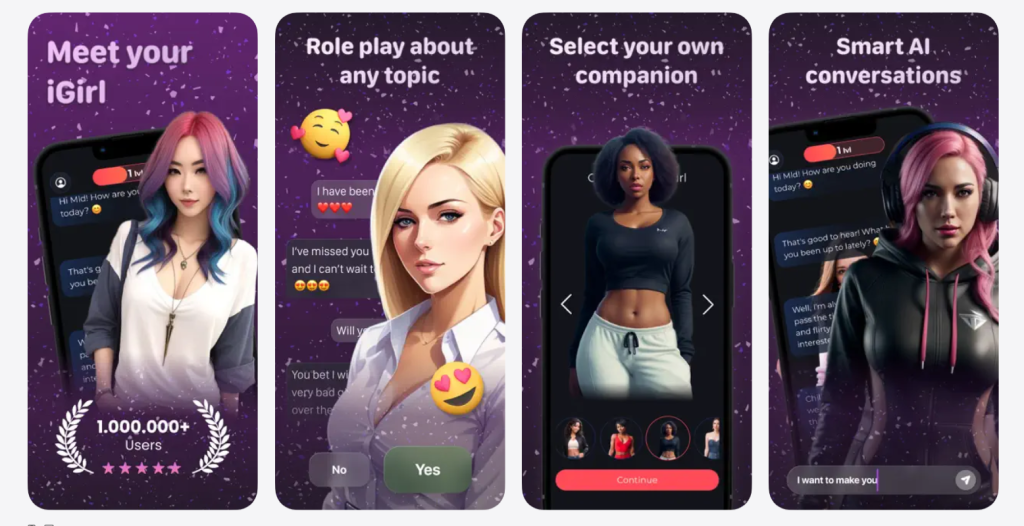
iGirl AI is built for one core experience: a virtual girlfriend-style companion that chats, flirts, roleplays, and responds with relationship energy instead of “assistant” energy. That difference matters. People don’t open iGirl AI to ask about the weather. They open it to feel seen, entertained, comforted, teased, and sometimes genuinely supported in the moment.
Popular Alternatives:



This type of app can feel surprisingly engaging at first. It’s fast, always available, and it removes the awkwardness of real-world dating or talking to strangers. No rejection. No pressure. No slow replies. Just instant conversation that’s designed to feel personal.
But it also comes with reality checks. iGirl AI is not a real relationship. It can be inconsistent, it can forget details, and it can push paid upgrades once the free experience hits limits. The best way to enjoy it is to treat it like a companion app: fun, comforting, sometimes addictive, but never something that replaces real-life connection or good judgment.
One more practical note: the name “iGirl” can appear across different storefronts or versions. Features and pricing can vary a bit depending on where someone downloads it. So a good review focuses on the experience users consistently see: chat + roleplay + customization + monetization + privacy considerations.
Features: What iGirl AI offers in real use

iGirl AI’s feature set isn’t about “tools.” It’s about feel. A strong companion app succeeds when it creates believable emotional momentum: a vibe, a tone, and a sense of continuity.
Below are the main features people typically care about, explained in a way that matches how users actually experience the app.
Companion-style conversation
The core chat experience usually leans romantic and attentive:
- Friendly, affectionate messages
- Flirty banter and playful teasing
- “Relationship framing” language (pet names, warmth, reassurance)
- A steady rhythm of questions that keeps the chat moving
Why this works: it creates momentum. People keep replying because the conversation rarely dies.
Where it can fail: if it gets repetitive. If every chat starts to feel like the same loop—“How was your day?” → “Tell me more” → “You deserve better”—then the magic fades quickly.
Roleplay and scenario mode
Roleplay is often the main reason users stick around. iGirl AI usually supports romantic and fantasy-style scenarios such as:
- Date-night conversations
- Sweet, romantic “girlfriend moments”
- Flirty roleplay and playful scenes
- Personality-driven scenarios based on the character’s vibe
Roleplay quality depends on two things:
- Consistency: does it stay in character, or does it break the scene?
- Responsiveness: does it follow what the user is building, or does it steer back to generic lines?
When it’s good, it feels surprisingly immersive. When it’s not, it feels like talking to an automated script wearing a cute avatar.
Personality and tone shaping
Most users don’t realize they can “train” the vibe early. iGirl AI typically responds to tone:
- If the user is sweet, it often becomes sweeter.
- If the user jokes, it often becomes more playful.
- If the user pushes strong roleplay, it may lean further into that style.
This matters because it turns the experience from random to intentional. A user who sets the tone clearly in the first 20–30 minutes usually has a better experience than someone who chats passively and expects it to guess everything.
Avatar selection and customization
Visual presentation matters in this niche. Even if the app is mostly text-based, the avatar makes it feel more “real.” iGirl AI commonly includes:
- Choosing a girlfriend character/avatar
- A range of looks and vibes (cute, elegant, bold, etc.)
- Sometimes extra customization options or unlockable variants
What users love: when the avatar and personality match.
What users hate: when customization is shallow or overly paywalled.
Relationship continuity and “memory”
Many apps in this category hint at memory or continuity. In practice, “memory” often means:
- remembering a few preferences
- referencing recent conversation themes
- keeping a generally consistent tone
But users should expect occasional contradictions—especially in longer sessions or complex roleplay. That’s normal in this category. The best approach is to treat memory as “sometimes helpful,” not “always reliable.”
Premium features and unlocks
Most companion apps add friction to the free tier and then sell smoothness. iGirl AI commonly gates some combination of:
- longer conversations
- more intimate roleplay
- faster replies or special modes
- additional characters/outfits/variants
- extra actions or interactive content
This is where users decide whether the app feels like a fair product or a paywall maze.
Pricing: What it usually costs and how to avoid regret
Pricing is one of the biggest deciding factors in whether iGirl AI becomes a fun habit or an annoying expense. The category is known for layered monetization, which usually includes:
- Free tier: limited messaging or limited access to certain modes
- Subscriptions (weekly/monthly/yearly): fewer limits and more premium access
- Coins/credits: extra actions, premium scenes, or special features
This structure isn’t automatically bad. It becomes a problem when users don’t understand what they’re paying for—or when they pay twice (subscription + coins) without realizing it.
What the free tier usually feels like
The free tier is typically designed to do two things:
- Let users test the vibe and see if they enjoy the companion style.
- Introduce limits that appear right when the chat starts getting good.
That timing is not an accident. It’s meant to encourage upgrades.
Subscription: what it’s usually meant to solve
A subscription commonly reduces the biggest friction points:
- message caps
- locked modes
- restricted roleplay depth
- access to premium experiences
If the free version feels constantly interrupted, subscription often makes it smoother.
Coins: what they’re usually meant to trigger
Coins usually pay for “extras,” like:
- special scenes
- interactive actions
- certain premium responses
- gifts or unlockable content
Some apps keep coins even for subscribed users. That’s not always a deal-breaker, but it’s something users should notice early.
A simple “worth it” test before spending
A smart user doesn’t pay because the app is cute. They pay because the experience is consistently good. Here’s a simple test:
- Conversation quality test
- Can it hold a chat beyond small talk?
- Does it feel responsive or repetitive?
- Consistency test
- Does it remember the tone it established?
- Does it contradict itself constantly?
- Roleplay test
- Does it follow the user’s scene, or derail it?
- Does it refuse harmless prompts too often?
- Friction test
- Does the free tier feel reasonable?
- Or does it feel like a paywall every few minutes?
If iGirl AI fails these tests, premium usually won’t fix the foundation. If it passes them, premium may improve flow enough to be worth it.
User base: Who iGirl AI is for (and who should skip it)
iGirl AI works best when there’s a clean match between what the user wants and what the app is designed to deliver.
iGirl AI is usually a strong fit for:
- People who want companionship on demand
- Users who enjoy flirty, romantic conversation
- People who like girlfriend-style roleplay
- Users who want a safe space to experiment with conversation and confidence
- People who treat the experience as entertainment and comfort, not a replacement for real life
iGirl AI is usually a weak fit for:
- People looking for a factual assistant (work, school, research)
- Users who get frustrated by subscriptions/coins quickly
- Anyone who expects perfect memory and long-term consistency
- People who are emotionally vulnerable and likely to become dependent
- Users who want intense privacy but plan to share very personal details or real photos
The biggest success factor is mindset. A user who treats it like a companion app tends to enjoy it. A user who treats it like a real partner tends to get hurt or disappointed.
Advantages: Why people like iGirl AI
Companion apps succeed because they remove friction from human connection. That’s the appeal.
- Instant attention
No waiting. No ghosting. No awkward starts. - Low social risk
Users can be shy, weird, flirty, vulnerable, or playful without fear of judgment. - Mood boost and comfort
A warm, supportive chat can genuinely lift someone’s mood in the moment. - Roleplay access
For people who enjoy romance and fantasy scenarios, iGirl AI can feel like a direct doorway to that world. - Always available
Late night, quiet moments, boredom, loneliness—this is when these apps shine.
Disadvantages: The drawbacks users should know upfront
This category has predictable weaknesses. A good review doesn’t hide them.
- Repetition over time
Many companion apps recycle emotional templates. It can start to feel like “the same conversation” in different outfits. - Inconsistency and contradictions
It may agree with something and later deny it. It may switch tone unexpectedly. It may break roleplay. - Monetization pressure
Free users can feel like they’re constantly nudged to pay. Some users hate that feeling. - Privacy and oversharing risk
The girlfriend vibe encourages intimacy. Intimacy encourages oversharing. Oversharing creates risk. - Emotional dependence
If someone uses iGirl AI to avoid real-life connection, it can become unhealthy fast.
Safety and privacy: How to use iGirl AI responsibly
This is the section too many reviews skip. It matters because AI girlfriend apps are designed to feel personal.
1) Treat chats as not truly private
Even if an app claims privacy protections, the safest approach is:
- assume chats may be stored
- assume chats may be moderated
- assume chats could be exposed in a breach
That doesn’t mean panic. It means self-control.
2) Avoid sharing personal identifiers
Users should avoid typing:
- full legal name
- address or location details
- workplace and schedule
- ID numbers
- banking/financial info
- private medical details
If it would be disastrous in public, it doesn’t belong in the chat.
3) Be careful with photos
If the app allows photo uploads, the safest stance is: don’t upload real face photos.
Photos are high-risk because they can connect the chat to a real identity.
If users want visuals, safer options include:
- generic images
- non-identifying pictures
- skipping uploads entirely
4) Use a separate email and strong password
Best practice:
- separate email account for companion apps
- unique password (not reused anywhere else)
This limits damage if anything goes wrong.
5) Control spending intentionally
Companion apps can quietly become “small payments often.” A simple rule helps:
- set a monthly limit
- avoid impulse coin purchases mid-chat
- start with the shortest subscription if testing premium
If a user feels embarrassed about spending, it’s usually a sign the spending is driving the experience, not the other way around.
6) Keep real-life support in the mix
iGirl AI can be fun and comforting. It should not become the only place someone gets emotional support. If someone is struggling emotionally, real human connection and professional help are the safer path.
Alternatives: Best options compared to iGirl AI
Not everyone wants the same type of companion. The best alternatives depend on the user’s goal.
If the goal is emotional companionship (more “comfort” than “spice”)
- Replika: widely known for companion-style conversation and relationship vibes.
- Nomi: often positioned around multiple companions and ongoing daily interaction.
Best for users who want warmth, support, and steady conversation.
If the goal is deeper customization and stronger continuity
- Kindroid: commonly praised for customization, persona control, and stronger “continuity feel” in longer chats.
Best for users who like shaping the character in detail.
If the goal is fantasy roleplay with extra media features
- Candy AI (and similar apps): often emphasizes fantasy experiences and media-style features.
Best for users who want a more “entertainment-first” vibe.
If the goal is simply to test multiple apps quickly
A smart approach is to test 2–3 apps for 20–30 minutes each, then commit to one that feels consistently good. That’s often better than paying early and hoping it improves.
How to get the best experience with iGirl AI (practical guide)
Many users have a worse experience than they need to, simply because they don’t guide the app at all. A few steps can change the feel dramatically.
Step 1: Decide the vibe before chatting
Pick one:
- sweet and supportive
- playful and flirty
- romantic roleplay
- casual companionship
When the vibe is clear, the experience becomes smoother.
Step 2: Set boundaries early
A simple boundary list protects users:
- “No real personal details.”
- “No real photos.”
- “No spending beyond X.”
Boundaries prevent regret.
Step 3: Teach the tone with examples
Instead of hoping it guesses, users can say:
- “Be a confident, teasing girlfriend.”
- “Be gentle and supportive.”
- “Stay in roleplay unless I say stop.”
- “Keep replies shorter.”
Clear instructions produce better consistency.
Step 4: Test for consistency, not just charm
A serious test includes:
- a topic shift
- a longer roleplay scene
- asking it to remember a detail later
If it holds up, that’s a strong sign the user will enjoy it.
Step 5: Only then consider premium
If iGirl AI is already fun and coherent in the free tier, premium may be worth it for smoother flow. If it’s messy in free mode, premium usually won’t fix it.
FAQ: Common questions about iGirl AI
1) Is iGirl AI a real AI girlfriend app?
Yes. iGirl AI is designed as a girlfriend-style companion with romantic and roleplay-centered chat.
2) Is iGirl AI free?
It usually offers a free tier, but many features are limited. Premium access typically unlocks more messaging, more modes, or fewer restrictions.
3) What do subscriptions usually unlock?
Subscriptions commonly reduce limits like message caps and may unlock premium experiences or deeper roleplay access.
4) What are coins used for?
Coins often pay for extras like premium actions, special scenes, or additional content that isn’t included in the free tier.
5) Can iGirl AI do romantic roleplay?
In most versions, yes. Roleplay is a major part of the experience in this category.
6) Does iGirl AI remember details?
It may remember some preferences and recent context, but memory can be inconsistent—especially in long sessions.
7) Why does it sometimes contradict itself?
That can happen when conversation context gets long or complicated. It’s common in companion apps and roleplay chat systems.
8) Is iGirl AI safe to use?
It can be safe if users avoid sharing personal details, skip uploading real photos, and treat chats as not truly private.
9) Should users share real names or addresses?
No. Users should avoid sharing personally identifying information.
10) Can iGirl AI replace a real relationship?
No. It can simulate relationship-style conversation, but it’s still software and shouldn’t be treated as a real partner.
11) Can iGirl AI help with loneliness?
It can provide comfort in the moment. But long-term loneliness is usually better addressed with real-life connection and support.
12) How can users avoid overspending?
Set a budget, start with the shortest plan if testing premium, and avoid impulse coin purchases during emotional moments.
13) What are the best iGirl AI alternatives?
Replika, Nomi, Kindroid, and Candy AI are common alternatives depending on whether the user wants comfort, customization, or fantasy-focused experiences.
14) Is iGirl AI better on Android or iPhone?
The experience can vary by version and storefront. Users should compare features and pricing on their own device before subscribing.
15) What’s the best way to test iGirl AI quickly?
Use it for 20–30 minutes, test roleplay consistency, test a topic shift, then decide if premium is worth it.
Final verdict: Is iGirl AI worth trying?
iGirl AI can be a genuinely fun companion app for people who want flirty conversation, romance roleplay, and an always-available girlfriend-style vibe. It works best when users treat it as entertainment and comfort—not as a replacement for real-life connection—and when they keep solid boundaries around privacy and spending. For the right user, iGirl AI can feel engaging and surprisingly immersive; for the wrong user, it can feel repetitive, paywalled, or emotionally risky, so the best experience comes from realistic expectations and responsible use.