
ChatUp AI is built for one thing: fast, low-friction AI conversation that feels personal, fun, and easy to keep going.
Popular Alternatives:



The market for AI companion and roleplay apps is crowded, but ChatUp AI appeals to people who want quick access, lots of chat styles, and a simple way to jump between different “vibes” without setting up a complicated character.
That convenience is the hook. But it also raises the real questions: does ChatUp AI stay consistent over time, or does it drift into generic replies? Does it have enough customization to make the chats feel different, or does everything start sounding the same after a while? And how does pricing work once the free tier hits its limits?
This review breaks down ChatUp AI in practical terms—features, pricing logic, who it’s best for, key pros and cons, privacy and safety habits, alternatives, and the questions readers usually ask before committing.
Overview
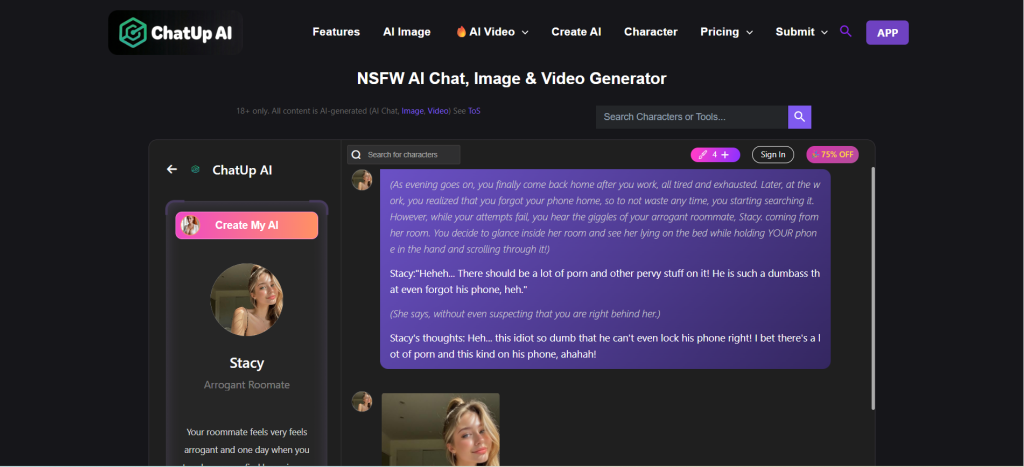
ChatUp AI is typically used as an AI chat and companion-style platform where users can interact with different conversation modes. Depending on how it’s set up, it may support:
- casual conversation
- flirt-forward chat
- roleplay-style scenarios
- “companion” interactions that feel more personal than a standard chatbot
The platform’s main advantage is speed and accessibility. It’s designed so users can start chatting quickly without spending a long time configuring characters. That makes it attractive to casual users and beginners.
The trade-off is also common in this category: less setup can sometimes mean less depth. If ChatUp AI doesn’t offer strong customization and memory features, it may feel fun in short bursts but less satisfying for long, story-driven sessions.
Features
ChatUp AI’s features can be grouped into three areas: chat experience, personalization, and quality-of-life.
1) Multiple chat styles and conversation modes
ChatUp AI usually tries to serve different user moods:
- friendly chat
- emotional support-style conversation
- roleplay scenarios
- flirt-forward conversation
This variety matters because it helps users avoid monotony. The best platforms in this space make it easy to switch tone without breaking immersion.
Actionable takeaway: If a chat starts feeling repetitive, switching modes or changing the scenario is often the fastest way to reset quality.
2) Roleplay and scenario support
Roleplay works when a platform follows instructions well. Even without deep “character building,” a user can get better roleplay by setting:
- the location
- the relationship context
- the tone (sweet, playful, intense, slow-burn)
- boundaries
Actionable takeaway: A short scene starter improves results instantly:
- “Keep it realistic and playful. Stay in scene. Ask one question per reply. Avoid repeating compliments.”
That simple structure keeps the chat moving forward.
3) Personalization and “companion feel”
Some versions of ChatUp AI offer personalization features that help chats feel more consistent, such as:
- saved preferences
- tone settings
- conversation “memory” that remembers recent details
- character selection or persona presets
If memory is limited, the user experience may feel like it resets between sessions. If memory is decent, the companion vibe improves dramatically.
Actionable takeaway: If memory is imperfect, re-anchor important details every 10–15 messages:
- “Still in the same vibe: calm, romantic, slow-burn, realistic tone.”
4) Response speed and usability
Many users stick with a platform because it feels smooth:
- quick responses
- minimal delays
- clean interface
- easy navigation
If ChatUp AI feels fast and frictionless, it can win even if it’s not the most advanced platform.
5) Safety controls and content boundaries
In companion-style platforms, responsible design includes:
- the ability to steer content tone
- user controls for blocking/reporting
- clear rules against illegal or exploitative content
Even in adult-leaning platforms, these controls matter.
Pricing
ChatUp AI commonly follows a familiar model:
- free to start
- limits that appear with usage
- paid tiers that unlock more access (often higher message limits and premium features)
Pricing structure details can vary by version or device, but the logic is usually consistent:
- free tier lets users test the vibe
- paid tiers remove friction and expand limits
What users should focus on isn’t the exact price. It’s the value:
- Does the free tier feel usable or constantly blocked?
- Does premium improve quality, or mainly remove limits?
- Is it easy to cancel?
Low-risk strategy before paying:
- Test three different chat styles.
- Run one longer conversation (15–25 exchanges).
- Try a roleplay scene and change the setting mid-chat.
- If ChatUp AI stays coherent and engaging, premium may be worth it.
User Base
ChatUp AI tends to attract users who want quick, entertaining conversation without the setup overhead of deep character-building platforms.
ChatUp AI is usually best for:
- casual users who want fast AI chat
- people exploring companion-style conversation for the first time
- users who like switching between different moods and tones
- anyone who wants short sessions that still feel personal
ChatUp AI may not be ideal for:
- users who want deep long-term story arcs
- people who expect perfect memory across weeks or months
- users who want highly advanced character creation tools
- anyone expecting unlimited free usage with no restrictions
Advantages
1) Fast onboarding and low friction
ChatUp AI is attractive because it’s simple. Users can jump in and chat without building a complex character profile first.
2) Flexible tone for different moods
Platforms that support multiple chat styles are easier to use long-term. ChatUp AI typically allows users to shift tone quickly, which reduces boredom.
3) Strong fit for casual daily use
For short chats, quick advice, light companionship, and fun conversation, ChatUp AI can be more “practical” than heavier roleplay platforms.
4) Smoother experience than many competitors
In this category, usability is a competitive advantage. If ChatUp AI feels fast and stable, it can outperform more advanced platforms that feel laggy or confusing.
Disadvantages
1) Can feel generic if customization is limited
If personalization tools are light, different chats may start sounding similar. That’s a common weakness in “quick chat” platforms.
Fix: Give sharper instructions:
- “Keep replies short. Avoid repeating compliments. Ask questions. Stay consistent with the chosen vibe.”
2) Memory drift can reduce immersion
Without strong memory, the companion feel weakens over time. Users may need to re-state details.
Fix: Re-anchor the scene and tone periodically.
3) Limits can interrupt the experience
If the platform uses caps or queues, free users may hit friction at the worst moments.
Fix: Treat the free tier as a trial. Upgrade only if the core experience already feels good.
4) Not ideal for long roleplay arcs
Heavy roleplay users may want deeper tools: strict character rules, long memory, and advanced scenario systems.
Safety
ChatUp AI can be used responsibly, but privacy habits matter—especially if users treat it like a companion.
1) Don’t share sensitive personal details
Avoid:
- address or exact location
- phone number
- workplace details
- financial or login information
- private photos or identifying details
2) Use a dedicated email when possible
A separate email keeps accounts compartmentalized and reduces exposure.
3) Keep roleplay fictional
Avoid involving real people in explicit scenarios. Fictional roleplay is lower risk and safer.
4) Watch emotional dependence
If users rely on ChatUp AI as a primary emotional support system, it’s a sign to rebalance:
- set time limits
- avoid late-night heavy chats
- keep real-world connection active
5) Control spending
If premium tiers exist, set a monthly budget and avoid impulse upgrades mid-session.
Alternatives
The best alternative depends on what the user wants more of.
1) More customization and deeper roleplay
Some platforms focus on character creation, strict behavior rules, and longer story arcs.
2) Stronger companion continuity
Some companion-first apps prioritize emotional flow, daily check-ins, and continuity.
3) Bigger character libraries
Some character-first platforms win on variety, discovery tools, and community-made personas.
4) More free-tier usability
If budget matters, some alternatives offer better free access without heavy friction.
Quick selection rule:
- Choose ChatUp AI-style platforms for speed and casual enjoyment.
- Choose customization-first platforms for deep roleplay.
- Choose companion-first platforms for continuity and relationship feel.
FAQ
1) What is ChatUp AI?
ChatUp AI is an AI chat and companion-style platform designed for quick conversation, roleplay, and personal-feeling interaction.
2) Is ChatUp AI free?
ChatUp AI typically offers free access to start, with limits that may lead users toward premium tiers.
3) Is ChatUp AI an AI girlfriend app?
It can be used that way depending on conversation style, but it’s generally a flexible AI chat platform rather than only an AI girlfriend tool.
4) Does ChatUp AI support roleplay?
Yes, roleplay-style conversation is commonly part of the experience.
5) Does ChatUp AI have memory?
Some versions include basic memory or preference saving, but memory depth can vary.
6) Why do chats sometimes feel repetitive?
Repetition happens when scenes are vague and the AI defaults to safe patterns. Clear instructions reduce loops.
7) How can users get better chats on ChatUp AI?
Set a tone, define a scene, add boundaries, and ask the AI to keep replies structured and consistent.
8) Is ChatUp AI safe to use?
It can be safer when used responsibly: avoid personal details, use strong passwords, and keep roleplay fictional.
9) Should users share personal photos or private details?
No. It’s safer to keep identity and sensitive information out of companion chats.
10) Can ChatUp AI replace real relationships?
No. It can simulate companionship, but it shouldn’t replace real-world connection.
11) Who is ChatUp AI best for?
Users who want quick, low-friction AI chat with flexible tones and casual companion vibes.
12) Who should avoid ChatUp AI?
Anyone under 18 for adult-leaning use cases, people who overshare personal info, and users expecting perfect memory.
13) Is premium worth it?
Premium is worth considering only if the free experience already feels coherent and fun. Premium should enhance, not rescue.
14) What’s the best way to keep chats coherent?
Re-anchor tone and context every 10–15 messages with a short recap and clear direction.
15) What are the best alternatives to ChatUp AI?
Alternatives depend on priorities: deeper roleplay control, stronger long-term companion continuity, or bigger character libraries.
Final Verdict
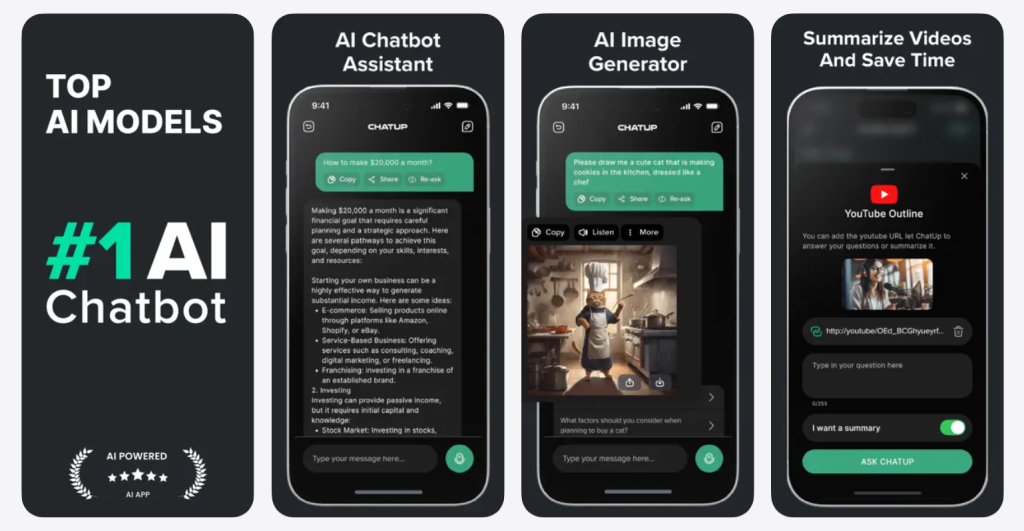
ChatUp AI is best for users who want a fast, simple, and flexible AI chat experience that can shift between casual conversation, companion vibes, and roleplay without heavy setup. Its strengths are convenience and variety—users can jump in quickly, change tone easily, and enjoy short sessions without needing advanced character building.
The biggest limitations are the usual ones in this category: chats can become generic without strong customization, memory may be limited, and free-tier limits can interrupt flow. Used with smart privacy habits and clear boundaries, ChatUp AI can be a solid pick for casual AI companion chat that stays enjoyable when users guide the vibe intentionally.