


Thundr sits in a messy corner of the internet where instant video chat can feel exciting, awkward, hilarious, or exhausting—sometimes all in one session.
Popular Alternatives:



One minute it’s a normal chat with a stranger. Next minute it’s someone trying to troll, spam, or push the vibe in a direction nobody asked for. That’s the reality of random video chat in 2026, and it’s why picking the right platform matters.
Last Updated: January 2026
How This Thundr Review Was Evaluated
This review looks at the things that actually change the experience on random video chat platforms—fast.
- Moderation strength: How quickly bad behavior gets stopped and how easy reporting feels
- Privacy/anonymity controls: Whether personal data is pressured out of users, and what can be hidden
- Pricing transparency: Whether paid features are clear, optional, and honestly described
- Ease of use (mobile/desktop): Whether it works smoothly without friction or constant errors
- Bot/spam prevention: How often fake users and scripted spam show up
- Filtering options (gender/location if relevant): Whether filters exist, how well they work, and whether they’re paywalled
- Overall user safety: The practical risk level for normal users and what reduces that risk
What Is Thundr?
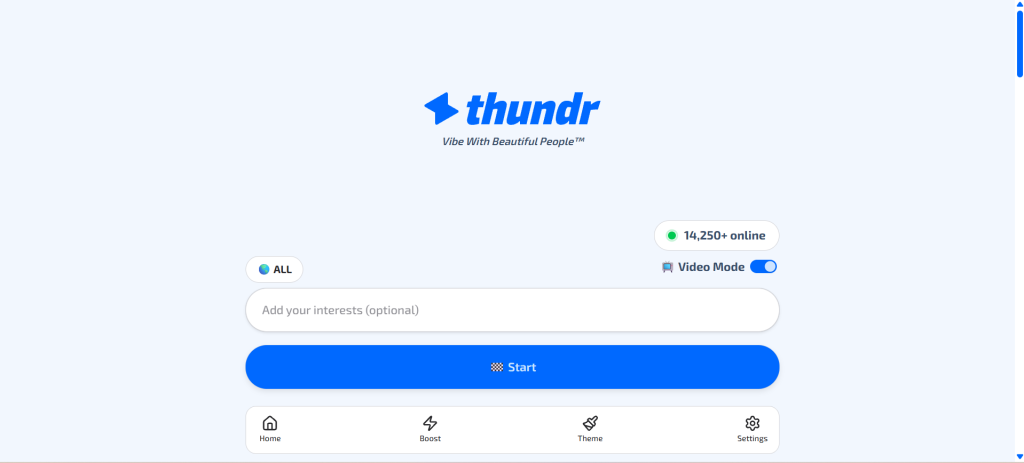
Thundr is a random video chat platform built for quick one-on-one conversations with strangers. It aims to keep things simple: open the site (or use it on mobile), allow camera/mic permissions, and start matching. No long profile-building. No complicated social feed to learn first. Just fast “start/next” style cam to cam chat.
It’s important to be clear about what it is not. It’s not a traditional dating app with verified identities, deep profiles, and slow messaging. It’s not a “safe by default” social network where every interaction is moderated like a classroom. It’s a live roulette-style video chat experience—so the quality depends on who is online and how strongly the platform enforces rules.
Quick answer: Thundr is best understood as an Omegle-style random video chat site with modern UI and basic safety tools. It’s designed for speed, not deep matching. Users who want structured dating features usually prefer a different type of platform.
How Thundr Works
The flow is straightforward, and that’s the point.
- Open the platform on desktop or mobile browser.
- Allow permissions for camera and microphone (or keep mic off if preferred).
- Start matching into a 1v1 video chat.
- Stay or skip depending on the vibe.
- Report or block if something crosses the line.
Most random video chat platforms follow this core loop, but the real difference is what happens inside that loop: match quality, lag, bot frequency, and how safe it feels when something goes wrong.
In practice, the user experience depends heavily on:
- Peak hours vs off-peak hours (more real users usually means fewer bots)
- Device + connection (mobile data can be rough for video)
- Whether filters are available (when they exist, they can improve match relevance)
- How strict moderation is (this changes everything)
Key Features and Standout Tools
Not every random chat site is trying to be “innovative.” Some just want to be usable. Still, a few features tend to shape how enjoyable sessions feel.
Common standout features users care about:
- Fast matching: The platform shouldn’t stall on “connecting…” for ages.
- Clean UI: Less clutter means faster decisions and fewer accidental clicks.
- Report/block tools: Must be visible and quick to use mid-call.
- Text chat option: Useful when audio is off, or when someone’s in a public space.
- Interest-style matching (when available): Helps reduce completely random mismatches.
- Mobile-friendly design: A lot of modern users start on a phone, not a laptop.
What matters most in real life:
A platform can have ten “features,” but if it’s flooded with bots or constantly exposes users to unsafe content, those features don’t matter. For most people, the real “standout tool” is strong moderation plus an interface that makes leaving instantly feel effortless.
Is Thundr Anonymous?
“Anonymous” in random video chat usually means no public profile and no requirement to post personal info. That’s different from being invisible.
In most cases, users can join without sharing a real name, social handles, or biography. That’s good. It lowers friction and reduces oversharing.
But anonymity has limits:
- IP addresses exist in the background (that’s normal for any online service).
- Other users can record screens (even if the platform forbids it).
- Anything said or shown on camera can be captured in seconds.
So the better way to think about it is this: the platform can reduce identity exposure, but it cannot prevent human behavior on the other side of the screen.
Quick answer: Thundr can feel anonymous because it’s built for instant matching, not public profiles. But true privacy still depends on user behavior: what gets shown, what gets said, and how quickly boundaries are enforced.
Safety, Moderation, and Privacy Controls
This is where most random video chat platforms either earn trust—or lose it permanently.
What “good” looks like:
- Clear community rules and visible enforcement
- Reporting that works in a few taps
- Quick disconnections for suspicious behavior
- Less obvious bot traffic
- Less repeated exposure to the same types of harmful interactions
What to watch for:
- Users pushing explicit content immediately
- Spam accounts promoting links or outside platforms
- Aggressive harassment, threats, or hate speech
- Attempts to get personal details fast (location, school, WhatsApp, Instagram, etc.)
Practical privacy controls that actually help:
- Keep the mic off until the vibe feels safe
- Avoid showing identifiable backgrounds (certificates, addresses, uniforms)
- Don’t share handles or phone numbers—especially early
- Leave fast if the chat turns manipulative or sexual when that’s not the goal
- Use the report tool instead of arguing
Random video chat is not automatically “dangerous,” but it does require a different mindset than normal social apps. The safest user is the one who treats every new match like a brand-new unknown environment.
Pricing, Payments, and Subscription Structure
Many platforms in this niche operate on a familiar model:
- Free access to core random video chat
- Ads shown to free users
- Optional upgrades for “better” features
The most common paid features across the industry include:
- Gender filters
- Location filters
- Faster matching or priority placement
- Reduced ads or ad-free sessions
- “Boost” style visibility upgrades
If Thundr offers paid features, the key question isn’t whether premium exists. Premium can be normal. The key question is clarity:
- Is pricing shown before charging?
- Is it easy to cancel?
- Are the features clearly explained?
- Does paid access actually improve match quality?
Smart approach: If premium is offered, treat it like a test. Use free mode first. If the free experience is chaotic, paid filters won’t magically fix everything.
User Experience (Mobile, Desktop, Sign-Up)
A lot of random video chat sites fail for simple reasons: they lag, crash, or feel clunky on mobile. User experience is not a “nice to have” here. It’s survival.
Desktop experience (typical strengths):
- Better camera stability
- Easier controls and faster skipping
- More reliable audio
- Cleaner layout on larger screens
Mobile experience (typical strengths):
- Convenient and fast access
- More casual “jump in and leave” usage
- Works well when the site is truly optimized for mobile browsers
Sign-up expectations:
Many platforms in this category allow instant access without full registration. Others may ask for lightweight info like age confirmation or basic preferences. Neither approach is automatically bad, but the safest experience usually comes from:
- minimal data collection
- clear permission prompts
- obvious privacy controls
Reality check: If a platform asks for too much personal info too quickly, that’s usually a red flag in this niche.
Pros and Cons
Pros
- Quick entry into random video chat without heavy setup
- Simple interface that suits “start/next” users
- One-on-one format keeps conversations focused
- Useful for casual social interaction when the user pool is strong
Cons
- Like all roulette chat platforms, match quality varies wildly
- Anonymity attracts trolls, spammers, and inappropriate behavior
- Safety depends heavily on moderation speed and user reporting
- Filters (if offered) are often limited or paywalled in this niche
Thundr vs Alternatives
No random video chat platform is perfect. The better question is: what kind of experience is wanted?
Below are strong alternatives depending on the goal:
1) OmeTV
Best for users who want a big user base and fast matching, often with a more “app-like” feel.
2) Chatroulette
Best for people who like the classic roulette vibe and don’t mind randomness.
3) Shagle
Often chosen for filter options and quick switching.
4) Chatrandom
Good for users who want variety (different chat modes) and broad access.
5) Camgo
Good for quick entry and simplicity, especially for casual chatting.
6) Emerald Chat
Better for users who want more structure and community-style features.
7) Monkey App
Popular with younger audiences and fast-paced matching, especially on mobile.
8) Chatspin
Often chosen for mobile-first design and a familiar swipe-to-next vibe.
9) CooMeet
Best for users who prioritize a “cleaner” matching experience, usually with a stronger paywall.
10) Tinychat-style rooms (group chat platforms)
Best when one-on-one feels too random and a room format feels safer or more entertaining.
Quick answer: Thundr works for people who want fast, no-fuss 1v1 chat. Users who want heavier filters, stronger structure, or more curated matches usually prefer a more specialized alternative.
Comparison Table
| Platform | Best For | Free Version | Moderation | Key Advantage |
|---|---|---|---|---|
| Thundr | Quick 1v1 random video chat | Yes | Medium | Simple, fast start/skip flow |
| OmeTV | Big user base & quick matching | Yes | Medium | App-like feel with broad reach |
| Chatroulette | Classic roulette-style video chat | Limited | Medium | Familiar “next” culture |
| Shagle | Filter-focused roulette chatting | Yes (limited) | Medium | Fast switching + filters |
| Chatrandom | Multiple chat modes | Yes (limited) | Medium | Variety of formats and options |
| Camgo | Simple browser-based chatting | Yes (limited) | Medium | Clean interface, low friction |
| Emerald Chat | More structured social vibe | Yes (limited) | Medium-Strong | Community feel + profiles |
| Monkey App | Mobile-first, fast interactions | Yes (limited) | Medium | Quick pacing and popularity |
| Chatspin | Mobile-friendly roulette chat | Yes (limited) | Medium | Smooth mobile experience |
| CooMeet | “Cleaner” matching focus | Limited | Medium-Strong | More curated, less chaotic feel |
FAQs on Thundr
Is Thundr free to use?
Many users access the core random video chat experience without paying. If premium features exist, they usually focus on filters, ad reduction, or priority matching rather than basic access.
Does Thundr require registration?
Some random chat platforms allow instant access with no account, while others may request light details like age confirmation or preferences. The experience can vary depending on region and device.
Is Thundr safe for teenagers?
Random video chat platforms are generally risky for minors due to unpredictable matches and adult behavior. Strong parental controls, strict supervision, and safer age-appropriate apps are recommended instead.
Can users choose who they match with?
Some platforms offer limited preference tools like gender or region selection. On many services, those tools may be restricted, limited, or part of premium features.
Does Thundr show ads?
Free random chat platforms often use ads to fund operations. Ad intensity varies, and some platforms offer ad reduction through upgrades.
Can users report someone on Thundr?
Most platforms include report and block functions. Those tools matter most when they’re easy to reach and taken seriously by moderation systems.
Is Thundr anonymous or can people track users?
It can feel anonymous because personal profiles aren’t the focus. But no live video platform can prevent screen recording or guarantee perfect privacy, so users should avoid sharing identifying details.
What should users never share on random video chat?
Full name, phone number, home address, school/work details, personal social handles, banking info, or anything that can be used to identify or pressure someone later.
Why do bots and spam happen on these platforms?
Bots thrive where access is easy and anonymity is high. They usually push links, scams, or repetitive scripts, especially during off-peak hours.
How can users reduce inappropriate matches?
Keep chats short until the vibe is safe, skip fast when needed, use report tools, avoid peak “chaos hours,” and consider platforms with stronger verification or stricter moderation.
Does Thundr work on mobile?
Many users access random video chat on mobile browsers. Performance depends on device, permissions, and connection quality, especially for video stability.
What’s the best alternative for safer chats?
“Safer” usually means stronger moderation, clearer rules, and better enforcement. Platforms with structured community systems often feel safer than pure roulette sites.
Can people get banned on Thundr?
Most random video chat platforms ban users who violate rules, especially for harassment, explicit behavior, or repeated reports. Enforcement consistency varies across the category.
Is Thundr good for dating?
It can lead to flirting or dating-style interactions, but it’s not built like a dating app. Users who want real dating features usually prefer profile-based dating platforms.
Final Verdict: Thundr
Random video chat is never fully predictable, and that’s exactly why the platform choice matters. The best experiences happen when the interface is fast, the reporting tools are obvious, and moderation is strong enough to keep normal users from constantly dealing with chaos. For users who want quick, low-friction 1v1 conversations and don’t mind the roulette-style randomness, Thundr can be a solid option.