Upward is a Christian dating app designed for single believers who want to meet people with similar faith, values, and relationship goals. Instead of trying to serve everyone, it focuses on Christian singles and presents itself as a simple, modern place where believers can connect, chat, and build meaningful relationships. That niche positioning is the main reason the app keeps drawing interest from users who feel mainstream dating apps can be too broad, too casual, or too disconnected from faith.
For many users, that focus is the biggest selling point. A general dating app may offer volume, but volume does not always translate into compatibility. Upward tries to narrow the field by centering shared beliefs from the start, which can save time and reduce the mismatch that often happens when faith is treated as a minor preference rather than a core value.
Last Updated: March 2026
What Is Upward?
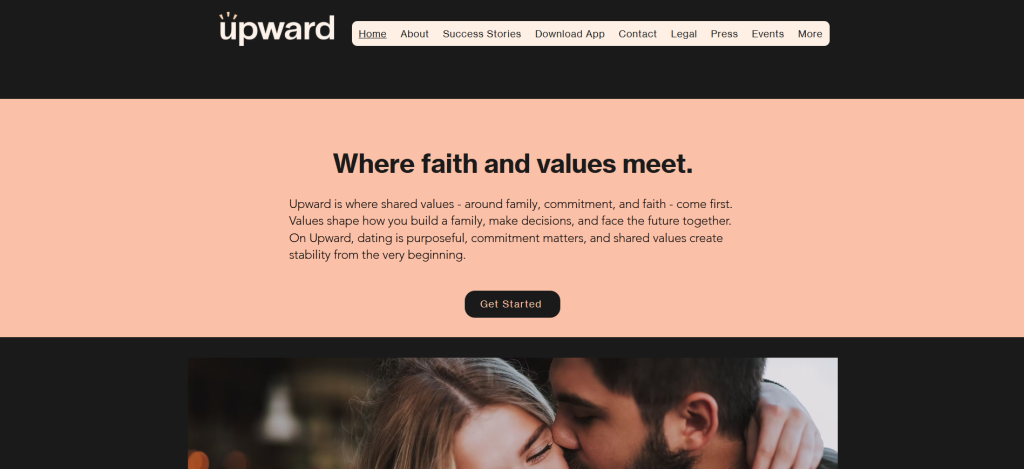
Upward is a dating app for Christian singles. Its official app store descriptions say it is a fun, fresh, free, and simple-to-use app where believers and people of faith meet, and that its mission is to create a faith-based community for single Christian men and women to connect through shared beliefs, shared values, and similar interests.
That matters because the app is not positioned as a generic swipe product with a Christian filter added afterward. Instead, Christian identity is placed at the center of the product itself. In practical terms, that means users join with a stronger expectation that religion, values, and long-term compatibility will be part of the conversation from the very beginning.
Upward also describes itself as the number one dating app for Christian singles in the United States in 2020 and 2021. Even though that claim refers to those years rather than the present, it still helps explain the brand’s positioning and why many users recognize it as one of the more visible Christian dating apps in the market.
How This Upward Review Was Evaluated
• Faith-focused positioning and how clearly the app serves Christian singles seeking meaningful relationships
• Ease of use based on the app’s simple, free-to-start, app-first experience
• Pricing visibility, including the presence of ads and in-app purchases on Google Play
• User experience signals from public app store descriptions, download scale, and ratings visibility
• Overall practical value compared with other Christian-focused and mainstream dating apps
• Community fit for users who want faith-based matching rather than broad mainstream discovery
How Upward Works
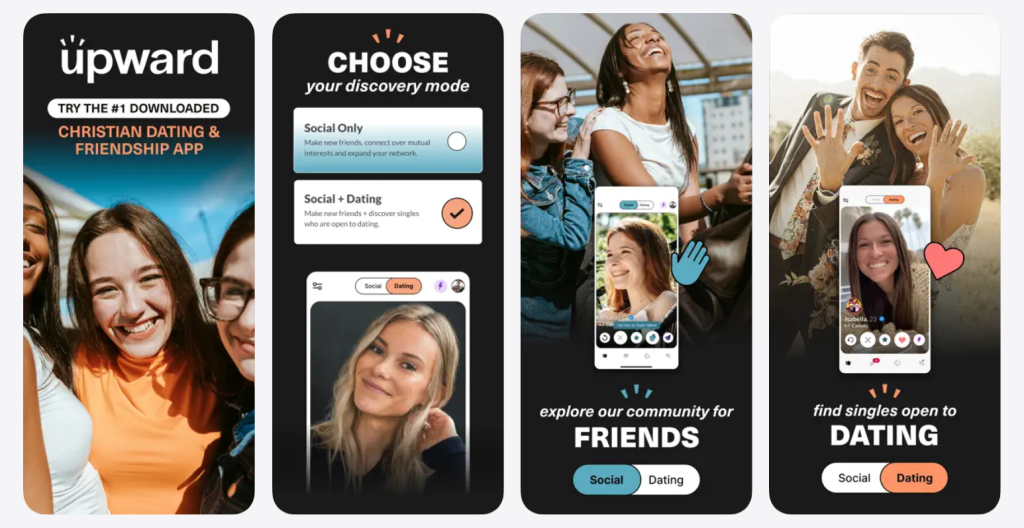
Upward follows the familiar dating app model that most users already understand. People create a profile, browse or discover other singles, connect when there is interest, and then move into chat. The difference is not the basic format. The difference is the audience. Upward is built specifically for Christian singles, so the matching pool starts with a shared faith angle instead of leaving that issue to chance.
The official store descriptions emphasize that the app is free and simple to use. That suggests Upward wants to lower the friction for first-time users who might be curious about Christian dating apps but not ready to commit to a heavily paywalled or overly complicated platform. At the same time, Google Play shows that the app includes ads and in-app purchases, which means the experience is free to start but still follows a monetized app model.
In practice, that makes Upward feel like a bridge between niche identity and mainstream app design. It is not presented like an old-school Christian dating website with a clunky interface and long sign-up flow. Instead, it appears to borrow the convenience of modern swipe-style dating while keeping the pitch centered on faith, values, and meaningful relationships.
That combination may be especially useful for younger Christian singles or anyone who wants a more current app experience without feeling like they have to rely on mainstream platforms where shared faith can get buried under broader dating goals.
Key Features and Standout Tools
The first standout feature is the niche itself. Upward is not vague about who it serves. The official app store descriptions make it clear that the app is for Christian singles and people of faith who want meaningful relationships. That alone gives it a more focused starting point than Tinder, Bumble, or other broad-market options.
The second standout point is simplicity. Upward repeatedly describes itself as fun, fresh, free, and simple to use. That wording may sound like basic marketing language, but it still matters because niche apps often lose users when they feel outdated or difficult to navigate. A Christian dating app does not only need a strong niche. It also needs to feel modern enough to compete for attention.
Another useful strength is the app’s emphasis on meaningful relationships. The official descriptions do not frame Upward as a purely casual app. Instead, they present it as a place where Christian singles can connect and build something more substantial. That does not guarantee every user is serious, of course, but the platform’s identity clearly leans toward compatibility and intent rather than pure fast-paced swiping.
There is also evidence of scale. Google Play lists more than 1 million downloads, which is not a trivial number for a niche dating app. Scale does not guarantee quality, but it does matter because niche dating products often live or die based on whether enough people are actually using them. A Christian app with too little traction can feel empty. Upward appears to have reached a level of visibility that gives it a stronger shot at remaining useful across more regions than a tiny unknown alternative.
Is Upward Safe, Private, or Trustworthy?
Upward appears more trustworthy than a random, low-visibility niche app for a few simple reasons. It has official listings on both the Apple App Store and Google Play, it has a clear brand identity, and it has a visible user base at scale on Google Play. Those are not perfect guarantees, but they do suggest a more established product than something obscure with little public footprint.
That said, public store descriptions do not provide a detailed safety center or deep privacy breakdown in the same way some other platforms do. Because of that, users should avoid assuming that a Christian brand automatically means a safer environment. Faith-based branding can create a more intentional community, but online dating still comes with the usual risks: fake profiles, mismatched intentions, oversharing too early, and off-platform communication that moves too quickly.
A sensible way to think about Upward is this: the niche may help with value alignment, but personal caution still matters. Users should take time to verify who they are speaking to, avoid sending private information too fast, and treat early conversations with the same level of care they would use on any other dating platform.
From a trust perspective, the app’s store presence, millions of downloads, and clearly defined audience all help its credibility. Still, users looking for detailed public safety features may want to verify current in-app tools and policies directly before relying too heavily on assumptions.
Pricing, Payments, and Subscription Structure
Upward presents itself as free to use, and both the Apple App Store and Google Play descriptions reinforce that free-to-start positioning. However, Google Play also clearly labels the app as containing ads and in-app purchases, which means the platform uses the common freemium model rather than a purely free one.
That is a familiar structure in dating apps. A free layer helps users enter the ecosystem without commitment, while upgrades and paid features usually monetize visibility, convenience, or other enhanced functions. Since the public store snippets available here do not clearly publish one single official universal price list, users should check live in-app pricing before making assumptions about value. That is especially important because app prices can vary by region, operating system, or active promotion.
The bigger question for most users is not whether the app has paid elements. Most dating apps do. The real question is whether the free version is usable enough to test the platform properly before paying. Based on how Upward markets itself, it appears to want a low-friction entry point, which is a positive sign for users who want to explore the app before deciding whether premium options are worth it.
User Experience
Upward seems designed for users who want a modern mobile-first dating experience without giving up a clear faith-based identity. That balance matters. A lot of people want something more targeted than Tinder but do not want to go back to an older, website-heavy Christian dating environment that feels slow or outdated.
The app’s language around being simple and easy to use suggests it is trying to remove friction rather than add too much complexity. For Christian singles, that is likely one of its biggest advantages. Instead of spending time filtering through a broad secular pool, users can start in an environment where belief is already part of the platform’s core purpose.
The experience will probably be strongest for people who already know they want a faith-centered relationship. For that type of user, Upward may feel more efficient and less exhausting than general-market apps. On the other hand, someone who wants the absolute largest possible dating pool may still find a niche app limiting in certain locations.
Google Play also shows a 3.7-star rating with tens of thousands of reviews and over 1 million downloads, which suggests a product with real traction and mixed but substantial user feedback at scale. That kind of footprint is important because it usually means the app has been tested by enough people to reveal both its strengths and its frustrations over time.
Pros and Cons
Pros
Upward has a clear niche, which immediately helps it stand out from broad dating apps. It is built for Christian singles rather than everyone.
The app is free to start, which lowers the barrier for new users who simply want to test the platform.
It focuses on meaningful relationships and shared values, which may appeal to users who are tired of casual-first dating environments.
There is meaningful scale behind it, with more than 1 million downloads on Google Play. That is a strong signal for a niche app.
The app appears modern and accessible rather than overly formal or old-fashioned.
Cons
Publicly visible pricing details are limited in the available store snippets, so users need to verify current in-app costs themselves.
The app includes ads and in-app purchases, which means the free experience is not fully frictionless.
Because it is niche by design, the available pool may feel smaller than Tinder, Bumble, or Hinge in some places. This is an inference based on category dynamics rather than an official Upward claim.
Public store descriptions do not spell out a deeply detailed safety framework, so users may want to review live app policies and tools directly before relying on assumptions.
Upward vs Alternatives
Compared with Tinder, Upward offers less scale but more focus. Tinder is built for sheer volume and speed. Upward is built for Christian singles who want faith to be a central factor rather than a footnote. For a user who wants the biggest pool, Tinder may still win. For a user who wants stronger religious alignment, Upward is the more targeted choice.
Compared with Bumble or Hinge, Upward still stands out by narrowing the audience around belief. Bumble and Hinge can certainly include Christian users, but they are not built specifically for that purpose. Upward makes shared faith part of the entrance point, which can change the tone of the experience in a meaningful way.
Against other Christian apps, Upward benefits from recognizable positioning and large-scale download visibility. SALT, for example, also presents itself as a Christian-focused dating app and says users can join, meet, match, and message Christian singles free of charge, with subscriptions for extra features. Ark, meanwhile, markets itself as a Christian app made by Christians for single Christian men and women and emphasizes intentional dating. That means Upward is competing in a real category, not operating alone. Its edge seems to come from its scale, simple pitch, and strong app-store visibility.
Comparison Table: Upward
| Platform | Best For | Free Version |
Moderation | Key Advantage |
|---|---|---|---|---|
| Upward | Christian singles who want faith-based matching | Free to start + paid upgrades | Profile moderation with verification and reporting tools | Clear Christian focus and strong visibility in the niche |
| SALT | Christians who want free matching and messaging with optional premium features | Free core + premium upgrades | Community moderation with reporting and safety tools | Christian-only positioning with free core features |
| Ark | Christian singles who want intentional dating language and a modern app tone | App-based pricing | Platform moderation with reporting and account review | Strong Christian identity and intentional-dating framing |
| Tinder | Users who want the biggest pool and fastest onboarding | Free + paid upgrades | Automated moderation with user reporting systems | Huge user base and fast discovery |
| Hinge | Users who want deeper profiles and conversation prompts | Free + paid upgrades | Profile moderation and reporting systems | More profile depth and relationship-oriented design |
FAQs: Upward
Is Upward a Christian dating app?
Yes. Upward describes itself as an app for Christian singles and people of faith who want meaningful relationships.
Is Upward free to use?
It is free to start, but Google Play shows that it includes ads and in-app purchases.
Who is Upward for?
It is aimed at single Christian men and women who want to connect around shared beliefs, shared values, and similar interests.
Is Upward only for serious relationships?
Its public positioning leans toward meaningful relationships, although individual user intentions can still vary.
Does Upward have a large user base?
Google Play lists more than 1 million downloads, which indicates meaningful scale for a niche dating app.
Is Upward better than Tinder for Christians?
For users who want a Christian-first environment, Upward is more targeted. Tinder still offers a larger general dating pool.
Does Upward work like a normal swipe dating app?
It follows a familiar app-based dating format, but its main difference is the Christian audience and faith-centered positioning.
Does Upward have paid features?
Yes. Google Play indicates that the app contains in-app purchases.
Can non-Christians use Upward?
The app is clearly marketed to Christian singles and people of faith, so it is designed around that audience.
Is Upward trustworthy?
It appears more established than many small niche apps because it has official app store listings and a large download footprint, but users should still use normal online dating caution.
What makes Upward different from other dating apps?
Its main difference is focus. It is built around Christian values and meaningful relationships instead of broad mainstream dating.
Does Upward have a premium subscription?
The available public snippets confirm in-app purchases, but users should verify current premium plans and prices directly in the app.
Final Verdict: Upward
Upward stands out because it solves a specific problem clearly. Many Christian singles do not want to search through a broad dating pool hoping to stumble across someone who shares their beliefs. They want faith to be part of the foundation, not a late-stage compatibility test. Upward leans directly into that need by offering a simple, modern app experience built around Christian connection and meaningful relationships.
It is not perfect. Publicly visible pricing detail is limited, the free experience is still monetized, and any niche dating app can feel smaller than a mainstream giant depending on location. Even so, the app’s clear identity, large download base, and focused audience give it real strength in the Christian dating category. For users who want belief, values, and relationship intent to matter from the start, Upward is easy to take seriously. In that sense, the biggest reason to try Upward is also the simplest one: Upward is built for people who want Christian dating to feel like Christian dating.