
Boo is a personality-based dating and friendship app designed for people who want more than a looks-first matching experience. Instead of centering the app around pure swiping and surface-level attraction, Boo presents itself as a space where people connect through personality psychology, shared interests, and compatibility. That is the core of its appeal, and it is also the main reason the platform keeps standing out in a crowded dating market.
For many users, mainstream dating apps feel fast, noisy, and repetitive. Boo tries to offer something different. It uses personality types, interest communities, compatibility guidance, and friend-finding tools to make the experience feel more thoughtful and more conversational. In other words, it is not only trying to help people date. It is also trying to help them find like-minded people they genuinely click with.
Last Updated: March 2026
What Is Boo?
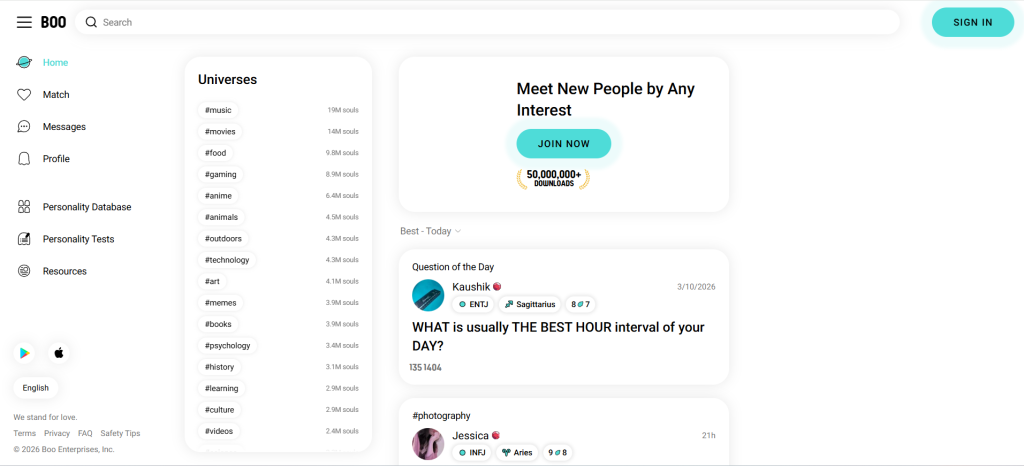
Boo is a dating, friendship, and chat app built around personality compatibility. Its official website and app store listings describe it as a place where users can date, chat, match, make friends, and meet new people by personality. The company says it uses personality psychology to help people find better dating and friendship matches, and it also offers a web version in addition to the mobile apps.
That positioning matters because Boo is not marketed as a pure dating app in the usual sense. It sits somewhere between a dating platform, a friendship app, and a social interest community. Users can look for romance, but they can also join conversations around shared interests and meet people through those spaces. That broader social layer makes the app feel less narrow than platforms built only around matching.
Boo also leans heavily into personality frameworks. The app store listings say it provides personality analysis, compatibility guidance, flirting tips, love-language insights, likely strengths, likely weaknesses, and related personality-based information. That is one of the clearest things separating Boo from more conventional swipe-first apps.
How This Boo Review Was Evaluated
• Official platform positioning and how clearly Boo explains its personality-based approach to dating and friendship.
• Feature depth, especially compatibility tools, communities, profile verification, and language support.
• Trust and safety signals, including verified profiles, privacy controls, and reporting features mentioned in public listings.
• Practical value for people who want personality-led matching instead of purely photo-driven discovery.
• Scale and public traction, including Google Play download figures and visible ratings volume.
• Overall usefulness compared with mainstream dating apps and more niche compatibility-focused alternatives.
How Boo Works
Boo works like a modern social dating app, but it adds a personality layer that shapes how people discover one another. Users create a profile, answer personality-related questions, browse potential matches, join interest communities, and chat with people based on shared values, interests, and type-based compatibility. Official listings say the app is for connecting with compatible and like-minded people for dating or friendship.
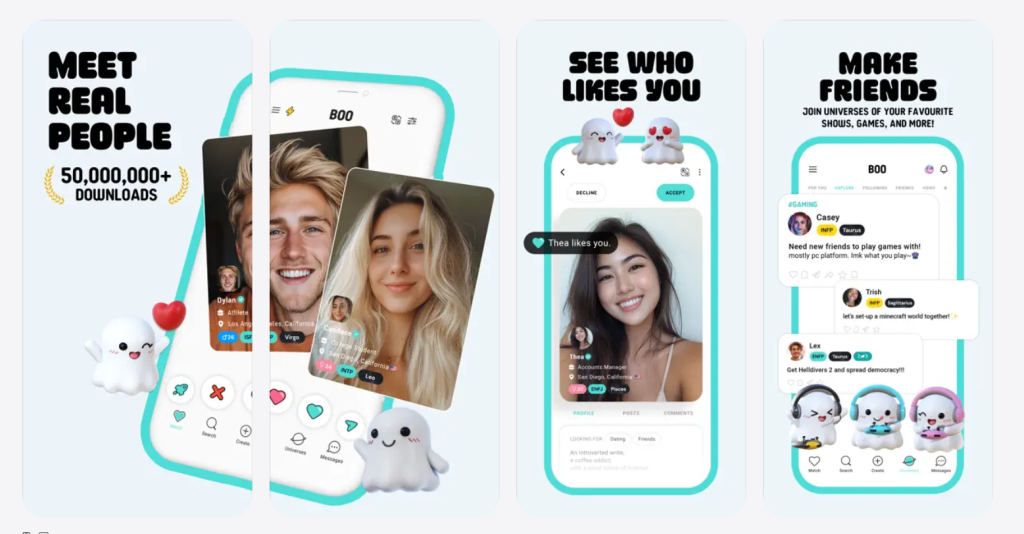
One of Boo’s most distinctive ideas is that it tries to help users understand each other rather than only notice each other. The platform says it offers insights such as likely strengths, weaknesses, love languages, flirting tips, ideal date styles, possible conflicts, and personality-driven attraction patterns. That turns the app into something more interpretive than the average dating product.
Boo also includes a social side beyond matching. Users can post in communities, discuss topics tied to shared interests, and meet people through those spaces rather than relying only on direct profile browsing. That can make the app feel more relaxed because not every interaction has to begin as obvious romantic interest.
The platform supports both dating and friend-finding, which broadens the use case. For some people, that is a strength because it reduces pressure and creates more natural connection paths. For others, it may blur intent slightly compared with apps designed strictly for romantic matching. That second point is an inference based on the app’s structure rather than a direct Boo claim.
Key Features and Standout Tools
The first standout feature is personality-based compatibility. Boo says it uses personality psychology to help users find people who will naturally understand and appreciate them. Whether a person is deeply into MBTI-style thinking or simply likes the idea of more meaningful compatibility cues, that feature gives the app a clear identity.
The second standout feature is its analysis tools. Boo’s listings mention personality analysis, dating advice, flirting tips, likely interests, love languages, potential conflicts, relationship fears, secret desires, enneagram details, and zodiac references. That is much more guidance than most dating apps provide, and it gives users more material to work with when trying to understand a match.
Another strong feature is verified profiles. Boo says users can get verified and use a verified filter to help avoid catfishes and bots. That matters because trust is one of the biggest pain points in dating apps, especially when platforms scale quickly.
The language and translation tools are also notable. Boo’s app store listings say users can translate profiles and messages and send messages in any language. That can make the app more useful for international users, multilingual users, or people who want to connect beyond their local linguistic bubble.
A final standout point is the blend of dating and communities. The app is not only about profiles. It also gives users interest-based spaces where they can post and interact around shared topics. For users who want more conversational discovery, that can be a meaningful advantage.
Is Boo Safe, Private, or Trustworthy?
Boo appears to have a better public trust story than many small dating apps. The app store listings mention verified profiles, while at least one Apple listing highlights privacy preferences and reporting inappropriate behavior as part of the experience. Those are useful trust signals because they show the platform is not relying only on branding to appear safe.
That said, no dating app is automatically safe just because it has verification or reporting tools. Users still need to stay cautious. They should take time to verify identity, avoid oversharing too fast, and use privacy controls intentionally. That is general safety reasoning rather than a Boo-specific claim, but it remains relevant in this category.
From a credibility perspective, Boo also benefits from scale. Google Play shows 10M+ downloads and a very large reviews count on the developer listing, which suggests the app has moved well beyond tiny niche status. A larger user base does not guarantee a perfect experience, but it usually means the product has had to operate at real scale.
Some surfaced review text also mentions features like Ghost Mode for anonymous browsing and user control around privacy. Since this came from public review text rather than Boo’s own core description, it is best treated as a feature signal that users should verify in the live app before relying on it heavily.
Pricing, Payments, and Subscription Structure
Boo is free to download and use, but it also includes ads and in-app purchases on Google Play. That means it follows the familiar freemium model rather than a fully paid-access model. Users can get into the platform without upfront payment, then decide later whether premium features are worth it.
The public sources surfaced here do not provide one clean, official universal pricing table for all markets. That is common with dating apps because prices can vary by country, platform, and active promotion. For that reason, users should verify current pricing inside the app before making assumptions about value. This is an inference based on the lack of a clear universal price in the surfaced official pages.
What does seem clear is that Boo wants users to be able to test the core concept first. The app’s public messaging focuses more on the functionality of matching, chatting, communities, and personality tools than on forcing a subscription pitch at the top level. That usually helps because a personality-led app needs users to experience the format before they can decide whether it works for them.
The practical question for most users is not whether Boo has premium elements, but whether the free experience is strong enough to judge the app properly. Based on the public listings, it appears the answer is yes, although power users may still prefer extra tools if they become very active on the platform. That second point is partly an inference from the freemium setup.
User Experience
Boo’s user experience seems built around curiosity and compatibility rather than urgency. That changes the atmosphere. A user opening Tinder often expects quick visual decisions. A user opening Boo is more likely to expect personality framing, community interaction, and a slower sense of discovery.
That can be a real strength. Many people say they are tired of shallow matching, but not every app actually offers a better alternative. Boo at least tries to. Between its personality tools, interest communities, verification, translation features, and compatibility framing, it offers more context than most mainstream apps.
The app also appears broad in purpose. Users can come for dating, but they can also come for friendship or like-minded conversation. For some people, that makes the experience feel more relaxed and natural. For others, it may slightly dilute romantic intent compared with apps that are purely relationship-focused. That second point is an inference from the product setup rather than an official Boo claim.
Public review snippets suggest users appreciate the personality focus and deeper conversations, while at least one review snippet points to frustration with how daily likes work. That kind of mixed feedback is normal at scale, but it does suggest the app’s value depends a lot on whether a user likes the personality-first format enough to tolerate standard dating-app limits.
Pros and Cons
Pros
Boo has a very clear identity built around personality compatibility rather than pure appearance.
It supports both dating and friendship, which broadens how users can connect.
The app includes personality analysis, compatibility guidance, flirting tips, and related tools that are more detailed than what most dating apps offer.
Verified profiles and reporting options help improve trust signals.
Translation features make it more accessible for cross-language interaction.
Cons
The personality-heavy framing may feel too elaborate for users who want a fast, simple dating app. This is an inference based on the app’s feature emphasis.
Because the app serves both dating and friendship, some users may feel romantic intent is less direct than on purely dating-focused platforms. This is an inference from the product structure.
The app includes ads and in-app purchases, so the experience is not completely friction-free.
Some review snippets suggest the like system can frustrate certain users.
Boo vs Alternatives
Compared with Tinder, Boo offers less pure speed but more context. Tinder is built around quick visual discovery and scale. Boo is built around personality, compatibility, and communities. Users who value depth may prefer Boo, while users who just want volume may still prefer Tinder. The Tinder comparison is partly general knowledge and partly an inference from Boo’s official positioning.
Compared with Bumble or Hinge, Boo still stands out because it leans harder into personality psychology. Bumble and Hinge may encourage better conversation than Tinder, but Boo goes further by turning personality frameworks into a central discovery tool rather than a side feature. This is an inference based on Boo’s official product description.
Against smaller compatibility-focused apps, Boo benefits from visible scale. Google Play’s 10M+ downloads suggest it has enough traction to avoid feeling like a tiny experiment. That can matter a lot because niche dating apps often sound clever but fail once users realize the pool is too small.
Comparison Table: Boo
| Platform | Best For | Free Version |
Moderation | Key Advantage |
|---|---|---|---|---|
| Boo | Users who want personality-based dating and friendship | Free + in-app purchases | Verification tools, reporting systems, and community moderation | Strong personality-compatibility focus with communities and translation tools |
| Tinder | Users who want the biggest mainstream dating pool | Free + paid upgrades | Automated moderation and user reporting systems | Huge scale and fast discovery |
| Bumble | Users who want a more structured mainstream app | Free + paid upgrades | Platform moderation with reporting and safety tools | Cleaner mainstream experience |
| Hinge | Users who want prompts and deeper profile interaction | Free + paid upgrades | Profile moderation with reporting and safety checks | More conversation-oriented design |
FAQs: Boo
Is Boo a dating app or a friendship app?
It is both. Boo officially says users can date, chat, match, make friends, and meet new people by personality.
What makes Boo different from other dating apps?
Its biggest difference is the personality focus. Boo uses personality psychology and compatibility guidance instead of relying mainly on looks and swiping.
Is Boo free to use?
Yes, at the entry level. Google Play shows it is free to install, though it contains ads and in-app purchases.
Does Boo use personality types?
Yes. Boo’s app listings say it uses personality psychology and provides detailed compatibility and personality insights.
Can users make friends on Boo?
Yes. Boo explicitly markets itself for both dating and friendship.
Does Boo have verified profiles?
Yes. Boo says users can get verified and use a verified filter to help avoid catfishes and bots.
Does Boo support multiple languages?
Yes. Boo’s listings say profiles and messages can be translated and that messages can be sent in any language.
How many users does Boo have?
Google Play’s developer listing shows 10M+ downloads for the app. App Store snippets also refer to over a million souls or millions of souls, depending on the region surfaced.
Is Boo safe?
Boo appears to have useful safety signals such as verified profiles, privacy settings, and reporting tools, but users should still follow normal online dating precautions.
What are Boo communities?
They are interest-based spaces where users can post and meet people through shared values and topics.
Does Boo have a ghost mode?
Public review snippets mention a Ghost Mode feature for anonymous browsing, but users should verify its current availability and limits in the live app because this surfaced through review text rather than a primary feature page.
Is Boo better than Tinder?
That depends on the user. Someone who wants personality-led matching and friendship options may prefer Boo, while someone who wants maximum scale and faster visual matching may prefer Tinder.
Final Verdict: Boo
Boo stands out because it tries to solve one of the oldest problems in online dating: too much surface, not enough substance. By centering personality psychology, compatibility signals, communities, and friend-finding alongside dating, it offers a more thoughtful alternative to apps that rely mostly on quick visual decisions. That alone makes it more interesting than many copy-and-paste dating products.
It will not suit everyone. Some users will find the personality-heavy format refreshing, while others may prefer a simpler or more direct dating experience. Even so, Boo’s scale, verified profiles, translation tools, and compatibility-driven identity give it a strong position in this niche. For users who want dating to feel a little more meaningful and a lot less random, the biggest reason to try Boo is simple: Boo is built for people who care about who someone is, not just how they look.